We use cookies to ensure that we give you the best experience on our website. By using this website you agree to the Privacy Policy and Terms of Use.

Pipeline
Science
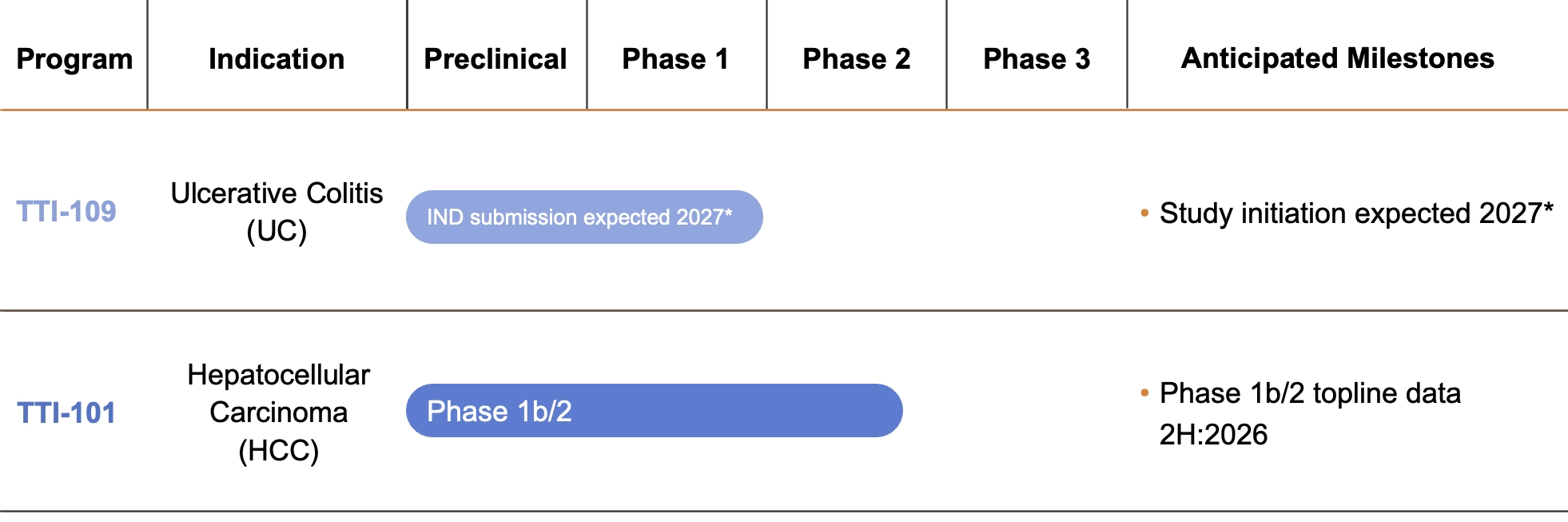
*Tvardi’s ability to initiate these programs is subject to clearance of Investigational New Drug (IND) application and the availability of additional funding.
Tvardi’s oral small molecule inhibitors of STAT3 specifically block activated STAT3 (pY-STAT3). They bind tightly to the SH2 domain of STAT3, which specifically blocks its ability to bind to signaling complexes that contain tyrosine kinases. This is designed to prevent STAT3 from being phosphorylated at tyrosine (Y) 705 and further prevent STAT3 dimerization and nuclear translocation. The selective binding to the SH2 domain thus inhibits STAT3’s canonical nuclear function, while preserving its essential non-canonical functions associated with cellular respiration within the mitochondria.
TTI-109, is an oral, small molecule STAT3 inhibitor that is structurally related to, yet chemically distinct from, TTI-101 and is designed to enhance the company’s ability to target STAT3.
In July 2026, Tvardi announced Phase 1 results for TTI-109, our next-generation STAT3 inhibitor. TTI-109 is a phosphate prodrug of TTI-101 designed to improve delivery and tolerability while preserving the parent compound’s mechanism of action. The study confirmed rapid prodrug conversion, dose-proportional pharmacokinetics with exposures above the STAT3 IC₅₀ and, in an exploratory pharmacodynamic analysis, reductions of up to 60% in STAT3-driven immune cell populations across Th17, Tfh and B cell subsets.
Key findings included:
- Confirmed prodrug conversion and exposure equivalence: Validating its prodrug design, TTI-109 rapidly converted to TTI-101 within two hours and produced nearly identical plasma levels at molar-equivalent doses.
- Sustained target-level exposure: 21-day repeat dosing showed stable, dose-proportional pharmacokinetics, with TTI-101 concentrations above the STAT3 IC₅₀.
- Evidence of target engagement: Pharmacodynamic data showed reductions of up to 60% across disease-relevant STAT3-driven immune cell populations including Th17 cells, Tfh and B cell subsets.
- Improved tolerability vs. TTI-101: Compared with placebo, diarrhea events with TTI-109 were similar in duration, transient, and resolved without treatment interruption. Compared with TTI-101 at near-equivalent doses, diarrhea events with TTI-109 were substantially shorter in duration (0.46 vs. 3.35 days).
Tvardi has identified dermatologic and gastrointestinal therapeutic areas with shared STAT3-driven disease biology, specifically the convergence of cytokines, growth factors and Th17 and B cell immune pathways at the STAT3 node. TTI-109 is designed to address both the cellular and humoral components of inflammation and proliferation with a single oral agent. Recent programs in related STAT3-driven indications have validated the underlying biology, but each acts on a single upstream target, while TTI-109 targets STAT3, the downstream node where these pathways converge.
In July 2026, Tvardi announced that it plans to initiate a study of TTI-109 in patients with moderate-to-severe UC in 2027, subject to clearance of Investigational New Drug (IND) application and additional funding. Tvardi is also conducting a Phase 2 clinical trial to investigate TTI-101 as monotherapy and in combination with standard of care (SoC) in patients with hepatocellular carcinoma (HCC). This study is an open-label clinical trial, designed to investigate the safety and efficacy of TTI-101 across three cohorts of patients with HCC: as monotherapy and in combination with SoC treatments pembrolizumab or atezolizumab + bevacizumab.
The FDA has granted Orphan Drug Designation as well as Fast-Track Designation for TTI-101 in HCC.